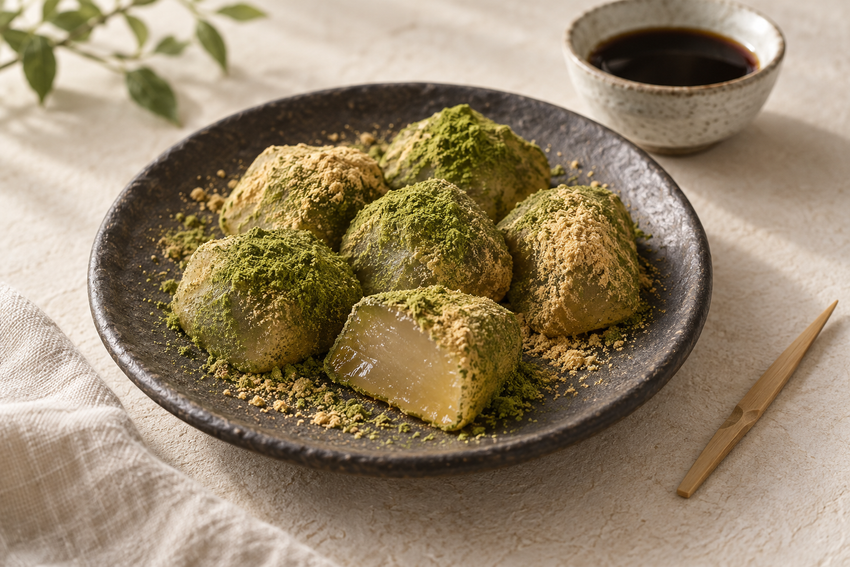
What Is Warabi Starch? The Rare Ingredient Behind Real Warabimochi
If you have ever bitten into warabimochi, you will remember it. It is cool, softly jiggly, almost translucent, and it melts away with a gentle sweetness. It looks like mochi, but it is not made from rice. Its secret is warabi starch — and the real thing, hon-warabi, is one of Japan's rarest traditional ingredients.

What Is Warabi Starch?
Warabi starch is made from the rhizome, or underground stem, of the warabi plant, wild bracken. The roots are harvested, washed, crushed, and washed again to extract the starch, which is then dried into a fine white powder. When mixed with water and heated, that powder turns into a clear, glossy, elastic jelly. That transformation is the heart of warabimochi.
In Japan, warabimochi has long been a summer sweet, served chilled and dusted with kinako, roasted soybean flour, and often drizzled with kuromitsu, a dark sugar syrup. It is light, refreshing, and delicate — a very different pleasure from chewy rice mochi.
Why Real Hon-Warabi Is So Rare and Expensive
Not all warabi starch is the same. Hon-warabi means the genuine article: starch made only from warabi root. Mukoh Matcha's Pure Hon-Warabi Starch 100g is described as 100% pure hon-warabi, made exclusively from wild warabi roots harvested in Southern Kyushu, in Kagoshima and Miyazaki Prefectures, with no added starches or fillers.
Wild warabi is not farmed on a large scale like rice or potatoes. Gathering and processing the roots takes time and care, and the amount of starch obtained is small compared with the work involved. That scarcity, and the demand from Japanese wagashi artisans who prize its deep transparency and elegant elasticity, is why genuine hon-warabi commands a high price. At ¥3,300 for 100g, it is an ingredient to use thoughtfully, for a special sweet rather than an everyday one.
Hon-Warabi vs. Common Alternatives
Walk through a Japanese supermarket and most packets labelled for warabimochi are not pure hon-warabi. They are blends, often based on potato, sweet potato, or tapioca starch, with a little warabi starch added. Those blends are cheaper, easier to find, and can make a pleasant jelly, but they are usually cloudier, firmer, and less delicate than the real thing.
By contrast, Mukoh Matcha's Japanese Premium Warabi Starch (200g, ¥1,200) lists lotus root starch, hon-warabi starch and modified starch among its ingredients — a blended, more accessible option for home cooks who want to try warabimochi without starting with the purest grade. The difference is a matter of purpose: a blend is a friendly introduction; pure hon-warabi is the traditional standard, prized for its clarity, softness, and clean flavour.
How to Make Warabimochi: The Basics
You need only a few things: warabi starch, water, and sugar, plus kinako and kuromitsu to serve. Using the recipe on the Pure Hon-Warabi Starch page, take 100g of pure hon-warabi starch, 400 ml of water, and 200g of white sugar, with kinako as needed.
Dissolve the starch completely in the water, add the sugar, and mix well. Heat over medium heat, stirring constantly. As the mixture thickens it will turn translucent and elastic. Reduce the heat to low and continue kneading for about 5 minutes, until it is glossy. Pour it into a mould or tray, let it cool, cut it into pieces, and coat generously with kinako. Serve chilled, with kuromitsu if you like.
The keys are constant stirring, so the starch cooks evenly, and patience at the end, so the texture becomes smooth and glossy rather than lumpy. Once you have made it, you will understand why the ingredients matter: with so few of them, there is nowhere for a lesser starch to hide.
Why Warabimochi Is Winning Fans Overseas
Outside Japan, warabimochi is becoming a discovery. Travellers post videos of its trembling, jewel-like cubes; cafes in major cities serve it as a light dessert; and home cooks, already curious about matcha, mochi, and wagashi, are looking for the next authentic taste to try. It fits a wider appetite for Japanese sweets that are delicate rather than heavy, subtly sweet, and beautiful to look at.
It is also a sweet with a story — a wild mountain plant, a traditional craft, and a texture unlike anything in Western desserts. That story is part of its appeal, and it is why many people, once they have tasted the real thing, want to know what made it different.
Try It Yourself
If you want to taste the difference, start with the real ingredient. Explore Mukoh Matcha's Pure Hon-Warabi Starch 100g (100% wild warabi root from Southern Kyushu, Japan, ¥3,300) — and make a small batch at home, chilled, dusted with kinako, and shared while it is fresh.
New to Japanese tea? Mukoh Matcha ships ceremonial-grade Yame matcha worldwide — start with our 6-variety Trial Set and find your favourite.